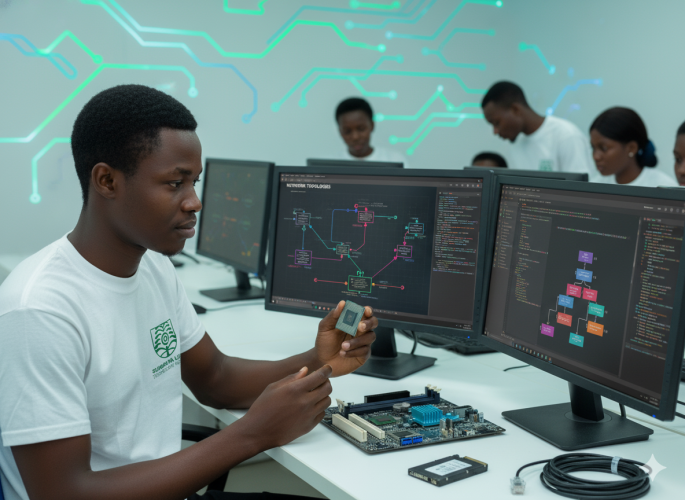
I.T fundamentals cover the basic concepts that explain what a computer is, how it works, and how it is used. At its core, a computer is an electronic device that takes input, processes it, stores the result, and produces output.
The major building blocks of a computer system are divided into two main categories:
Hardware: The physical, tangible parts of the computer.
Central Processing Unit (CPU): The "brain" of the computer that executes instructions.
Memory (RAM & ROM):
RAM (Random Access Memory): Volatile memory used for temporary storage of data and programs currently in use.
ROM (Read-Only Memory): Non-volatile memory that stores the permanent instructions needed to start the computer (BIOS).
Input Devices: Tools used to enter data into the computer (e.g., keyboard, mouse, scanner).
Output Devices: Tools used to present the results of processing (e.g., monitor, printer, speakers).
Storage Devices: Used for permanent storage of data (e.g., Hard Disk Drive (HDD), Solid State Drive (SSD), USB drives).
Software: The set of instructions or programs that tell the hardware what to do.
System Software (Operating System): Manages the computer's hardware and software resources, providing a foundation for application programs (e.g., Windows, macOS, Linux).
Application Software: Programs designed to perform specific tasks for the user (e.g., Word Processors, Web Browsers, Video Games).
Computers operate on an electrical signal that is either ON or OFF. This is represented by the Binary system (Base-2):
0 (Off/False)
1 (On/True)
The fundamental units of data are:
Bit (b): A single binary digit (0 or 1).
Byte (B): A group of 8 bits, which is the amount of storage needed to represent one character (like 'A', '7', or '$').
Larger units are used for capacity: Kilobyte (KB), Megabyte (MB), Gigabyte (GB), and Terabyte (TB).
A computer fundamentally follows a four-step process known as the Information Processing Cycle (or IPO Cycle):
Input: The computer receives data or instructions from an input device.
Processing: The CPU executes the instructions and performs calculations on the data.
Storage: The results are saved temporarily in memory or permanently on a storage device.
Output: The processed information (now called information) is presented to the user through an output device.


